Altos-Public-Spin-vs-Ottawas-Own-Words
Alto’s Public Spin vs. Ottawa’s Own Words
By Erin Durant | Substack.com/@TheAltoFiles
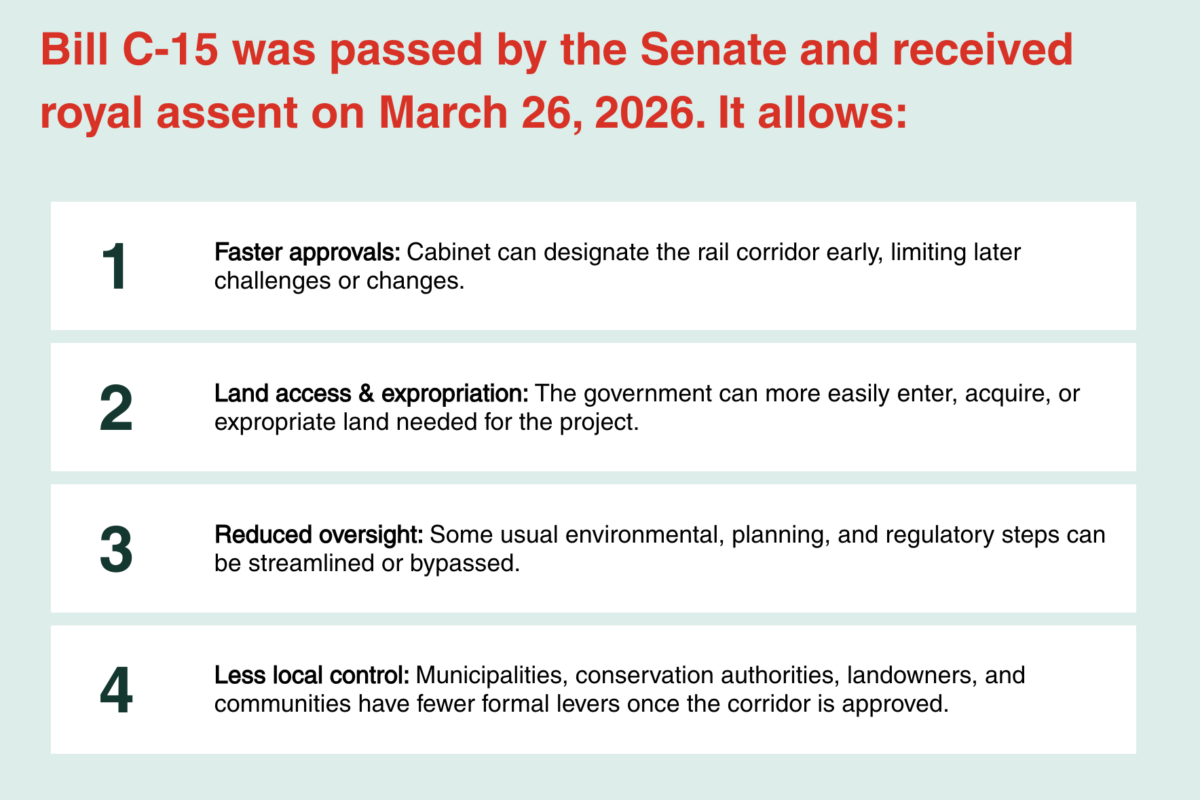
Before Bill C-15, a property owner who objected to a Notice of Intention to Expropriate was entitled to a public hearing. These are in-person proceedings before an independent hearing officer, who would then report the findings to the Minister. This is sometimes referred to, including in submissions made to the Senate committee studying the bill, as a “Hearing of Necessity.” Despite the removal of this process, Alto asserts publicly on its website and in the press that citizens’ rights have not been limited.
On April 2, 2026, Alto published a blog post answering what it described as “one of the most frequently asked questions” from its public consultation process: Does Bill C-15 change a property owner’s rights if their property is subject to expropriation? Alto’s answer, in full:
“Bill C15, which received Royal Assent on March 26, 2026, enacted the High-Speed Rail Network Act. This legislation aims to streamline and to improve the property acquisition process without limiting citizens’ rights. For example, the right of preemption does not prevent a property owner from selling their property on the open market, and work restrictions do not prevent necessary maintenance. In addition, the right to challenge an expropriation remains fully in force, including through the submission of a written objection that must be reviewed before any decision is made.”
Other parts of that statement are misleading (such as how difficult selling a property will actually be if placed under restrictions), but I’m focused on the limits placed on property owner rights.
Compare Alto’s statement to what Transport Canada’s legislative overview says about the same provision (this is a document published on the department’s binder page and last modified June 17, 2026, about eleven weeks after Alto’s FAQ went live):
“Public hearings: The requirement to hold a public hearing if an objection to a contemplated expropriation has been received will not apply in the context of the initiative. A person may still object to an intended expropriation in writing.”
The Government of Canada certainly understands the impact of the changes and talks about it openly internally. A briefing note prepared for the Minister of Housing and Infrastructure, dated March 17, 2026 (about two weeks before Alto’s FAQ was published) describes the legislation in similar terms to Transport Canada’s internally facing public binder, not to Alto’s public-facing language. The note, released under Access to Information request A-2026-00032, states that the High-Speed Rail Network Act, “introduces major efficiencies including prohibition of work and right of first refusal tools, removal of public hearing requirements, and streamlined expropriation.”
They didn’t even bother redacting that sentence. It isn’t seen as controversial or commercially sensitive. It’s literally the law. Citizens’ hearing rights were removed to expedite expropriation and facilitate Alto’s land acquisition activities.
The text of the High-Speed Rail Network Act is not ambiguous, and Transport Canada’s plain-language summary of it is not ambiguous either. The independent public hearing requirement is gone for this project. A written objection is not a substitute for a full public hearing; it is a different, narrower mechanism, reviewed by the same minister who is also responsible for the project’s success. Who would trust that to be an impartial process? Not me. But what do I know? I’ve spent most of my career, until recently, litigating in impartial tribunals and courts while ensuring fair hearings for my clients.
While hearings and due process may seem burdensome, research in the justice sector has shown that people tend to be better able to accept negative outcomes if they are presented with an opportunity to be heard by an independent adjudicator through a fair process. Not having the opportunity for such a hearing is one reason why I’m litigating my case against this project now, urgently and publicly.
Expropriations will happen “immediately” upon filing of the Impact Assessment project definition (according to MacKinnon). As a result, land between Ottawa and Montreal will be acquired in late 2026 and early 2027 (after they file the Impact Assessment project description) for a project that will: a) not have a final investment decision, b) not have any results from the impact assessment process which identifies the actual impacts of the project and c) (at this rate) before any business case or impact reports about this project has been released to the public at all. Add to all of this the fact that hearing rights were removed, and it all starts to feel very dystopian to be a resident in the corridor.
After Bill C-15, what remains is the ability to submit a written objection, which will be reviewed by the Minister of Transport, who will make the final decision. Given his and his government’s political interests in this project, I certainly wouldn’t trust the Minister with such a process. He clearly has an interest in the outcome. There is no public hearing, no independent officer, and no public accountability.
How is that not a limit on citizens’ rights?
Below is the justice sector research on the importance of having a fair and independent hearing process:
Thibaut, J., & Walker, L. (1975). Procedural Justice: A Psychological Analysis. Lawrence Erlbaum Associates. The originating work established that “voice” (the opportunity to present one’s case before a decision) and “process control” independently shape perceived fairness.
Lind, E. A., & Tyler, T. R. (1988). The Social Psychology of Procedural Justice. Plenum Press. Extends Thibaut & Walker into the “group-value” model: people read being heard as a signal of respect and standing, not just a route to a better outcome.
Tyler, T. R. (2006). Why People Obey the Law. Princeton University Press. Longitudinal evidence that “if a person who does not receive an outcome that they think favourable or fair feels that the decision was arrived at in a fair way, they are more likely to accept it,” and that this acceptance holds over time rather than reflecting mere short-term compliance.
Tyler, T. R., & Huo, Y. J. (2002). Trust in the Law: Encouraging Public Cooperation with the Police and Courts. Russell Sage Foundation. Field studies showing people are responsive to evaluations of the fairness of procedures, even when authorities do not provide the outcomes people hoped for.
Tyler, T. R. (2003). “Procedural Justice, Legitimacy, and the Effective Rule of Law.” Crime and Justice, 30, 283–357. Distinguishes “voice” and “neutrality” (fairness of decision-making) from “trust” and “respect” (interpersonal treatment) as the two components driving legitimacy judgments.
Leventhal, G. S. (1980). “What Should Be Done with Equity Theory?” in Social Exchange. One of the six widely-cited criteria for a “just procedure” is impartiality/neutrality of the decision-maker.
Tyler, T. R., et al. (1997), is cited as the basis for the “fair-procedure effect.” This is the finding that perceived procedural fairness “helps the parties to accept decisions or outcomes that are less favourable than they had expected and hoped for.”
Originally published at substack.com/@thealtofiles









Explore More...