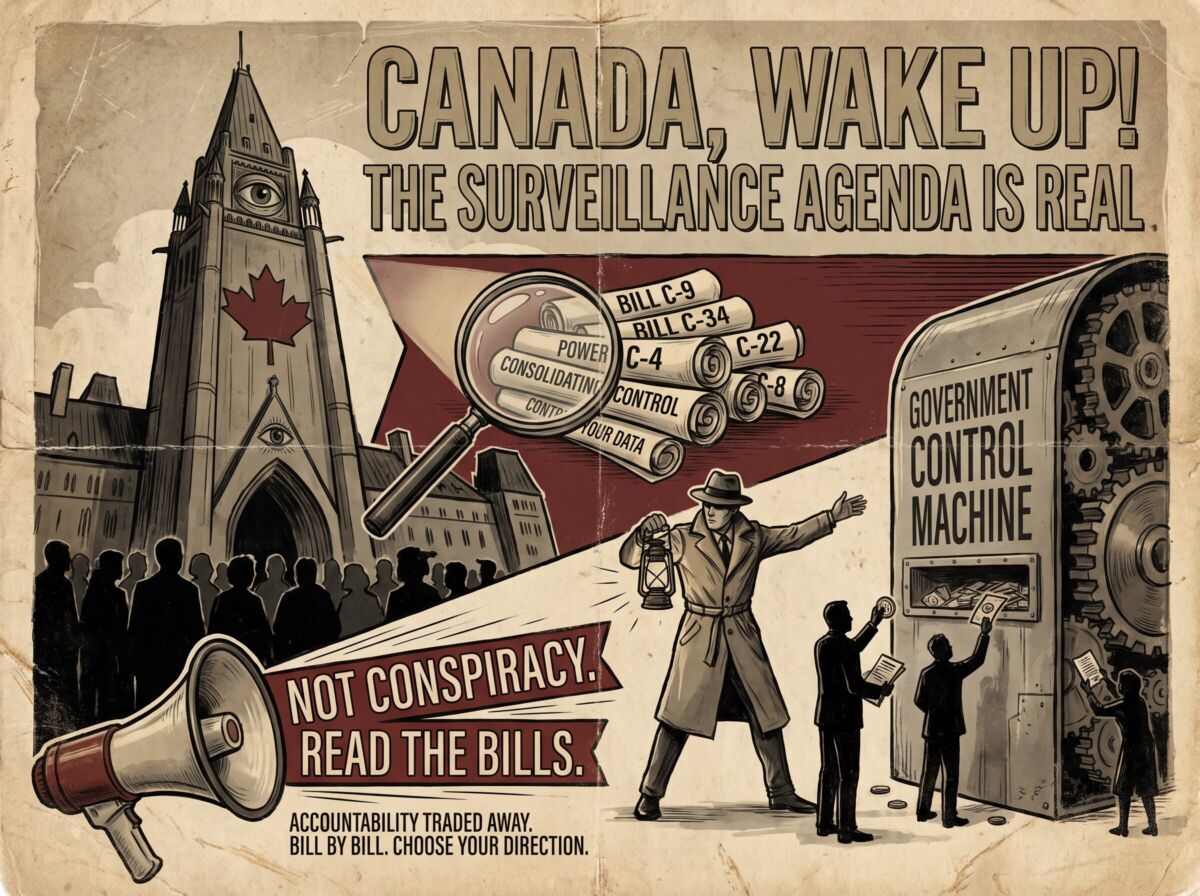
Eyes-Open-Canada
Eyes Open, Canada!
By Shawn Jason
People raising the alarm about Ottawa’s growing surveillance-and-control agenda got labeled conspiracy theorists. Tinfoil hats. Fear-mongers. But underneath the noise that gets mocked sits something real. Read these bills through the eyes of lawyers, privacy commissioners, and civil liberties groups who studied them line by line, and you find the people dismissed as paranoid were often pointing to real text in real legislation. Not always perfectly, perhaps, but the instinct was right: power is consolidating faster than the public can track.
This is not left versus right. It is the controlling class versus everyone else. Let’s go through these one at a time, and let’s not pretend there is no case for any of it, because there is. The government’s case is not the only thing happening, and what gets left out of the press release is usually what matters most.
C-9: A Law That Removed Brakes on Its Own Power
The Combatting Hate Act became law in June 2026, punishing hate-motivated violence outside places of worship, a goal almost nobody disputes. But it creates a hate crime offence that can push an underlying crime’s penalty to life imprisonment once a court decides hatred was the motive, and Centre for Free Expression warns this could sweep in flags tied to Palestinian, Kurdish, or other liberation movements, since Canada’s terrorist listing process is itself political.
More troubling, C-9 removed the requirement that the Attorney General sign off before a hate-propaganda charge could proceed. Any prosecutor can act alone now. It also repealed the long-standing “good faith religious opinion” defence for certain hate-propaganda offences—the kind of protection that let clergy preach difficult scripture without fearing the law. Faith leaders and over thirty thousand citizens who wrote their MPs said the same thing: once government decides which words count as hatred, the goalposts move whenever government changes hands.
C-34: Proving You Are Not a Minor
The Safe Social Media Act would ban social media accounts for anyone under sixteen, and that cannot be enforced by asking thirteen-year-olds to be honest. It has to verify everyone’s age, since there is no way to find minors without checking everyone first. The Justice Centre for Constitutional Freedoms put it plainly: the bill imposes a ban on some at the expense of every Canadian’s privacy, raising serious privacy and Charter concerns.
Platforms are turning to third-party identity verifiers, the same facial scanning and document upload services used elsewhere, meaning your face or government ID may now pass through a private company’s servers to keep using an app you’ve used for years. Newer technology can estimate age without confirming identity, which is fairer, but Canada’s own privacy office has named the bigger risk out loud: a system built to verify a population does not disappear once the rule changes. It stays, available for the next purpose.
Function creep is not a conspiracy theory term. It is the phrase regulators use for this exact risk.
C-4: Your Data, Their Rules, No Recourse
While Canadians focused on grocery prices, Parliament passed an affordability bill that quietly exempted federal political parties from provincial privacy law, retroactive to the year 2000. Law professor Michael Geist called it one of the most dispiriting digital policy stories in recent memory. No requirement to tell you why they collect your data. No consent requirement. No right to see what they hold on you. No retention limits, meaning they can keep it forever.
The Senate demanded a sunset clause. The government rejected that and rushed the bill to royal assent with almost no debate. The party asking for your vote can build a profile on your politics and behaviour, share it with third parties, and you have no legal standing to ask what they know.
C-25: Year-Round Rules, With Convenient Gaps
The Strong and Free Elections Act extends interference rules, bribery, foreign collusion, and computer tampering to apply year-round instead of only during a campaign, a reasonable response since bad actors do not wait for a writ. But Conservative MPs argued the bill still leaves a loophole for foreign money to flow into registered third-party groups. It also tightens access to the voter list, a change lawyer Gerald Chipeur called a cure worse than the disease, since publication of the voter list had never produced documented harm.
It closes some doors. It leaves others conveniently propped open. And the people already closest to power are usually the ones who know which doors matter.
C-22: They Know Who You Called, Soon Where You Stood
The Lawful Access Act will require telecoms to retain metadata on every Canadian for up to one year, suspected of anything or not, revealing who you called, when, and where you were. Geist called this one of the most privacy-invasive tools a government can deploy. The bill lowers the legal bar for confirming whether you use a service, from reasonable grounds to believe down to reasonable grounds to suspect, a standard the Canadian Bar Association called the lowest threshold in our legal system.
Apple warned it could force companies to break their own encryption. Meta said it would conscript private companies into government surveillance. Signal and several VPN providers threatened to leave Canada entirely. Citizen Lab warned it may pave the way for U.S. law enforcement to pull Canadians’ data directly from Canadian companies, bypassing our own courts.
C-2 and C-12: Following Money, Sharing It With Everyone
Bill C-2 proposed sweeping financial-surveillance powers, including mandatory FINTRAC enrolment, broader information sharing, and a ban on businesses, professionals, and charities accepting cash payments, donations, or deposits of $10,000 or more.
Bill C-12 later became law, carrying forward many border, immigration, and FINTRAC-related measures. But the $10,000 cash-ban offence appears to remain in C-2, not C-12. In other words, the cash ban has not become law—but it has been introduced, tested, and left sitting there for another push.
Fighting money laundering is not controversial. What matters is the direction. Cash keeps getting squeezed, digital assets are being folded into financial-crime policy, and agencies sharing your financial information keep growing.
C-8: Secret Orders, Silent Telecoms
Under the new Critical Cyber Systems Protection Act, a federal minister can issue secret orders to telecom providers without prior judicial approval, including orders critics warn could affect service access, privacy, and encryption. The government says the target is the network, not individuals, and the goal is responding to attacks on hospitals or power grids. But Citizen Lab researchers called the bill’s data powers an unprecedented warrantless authority to collect telecom data and share it across government, including with the Canadian Security Intelligence Service (CSIS).
The Canadian Civil Liberties Association said the encryption safeguard added to calm critics does not guarantee encryption stays intact. OpenMedia’s executive director put it bluntly: there is no such thing as a backdoor that exists only for law enforcement.
The Emergencies Act: We Already Watched This Happen
This is not theoretical. In 2022, the federal government invoked the Emergencies Act and froze bank accounts linked to Freedom Convoy protests, without a conviction or a court order specific to each account. The courts have since ruled the invocation unlawful and a violation of Charter rights, though the government is now asking the Supreme Court to hear an appeal. Whatever you think of the protest, the precedent stuck. Your government has already shown it will cut off financial access to people it deems a problem, without a court involved beforehand. Every bill since then that expands financial surveillance is built on a willingness we have already seen in action.
C-15: Not a Digital Dollar, But Its Foundation
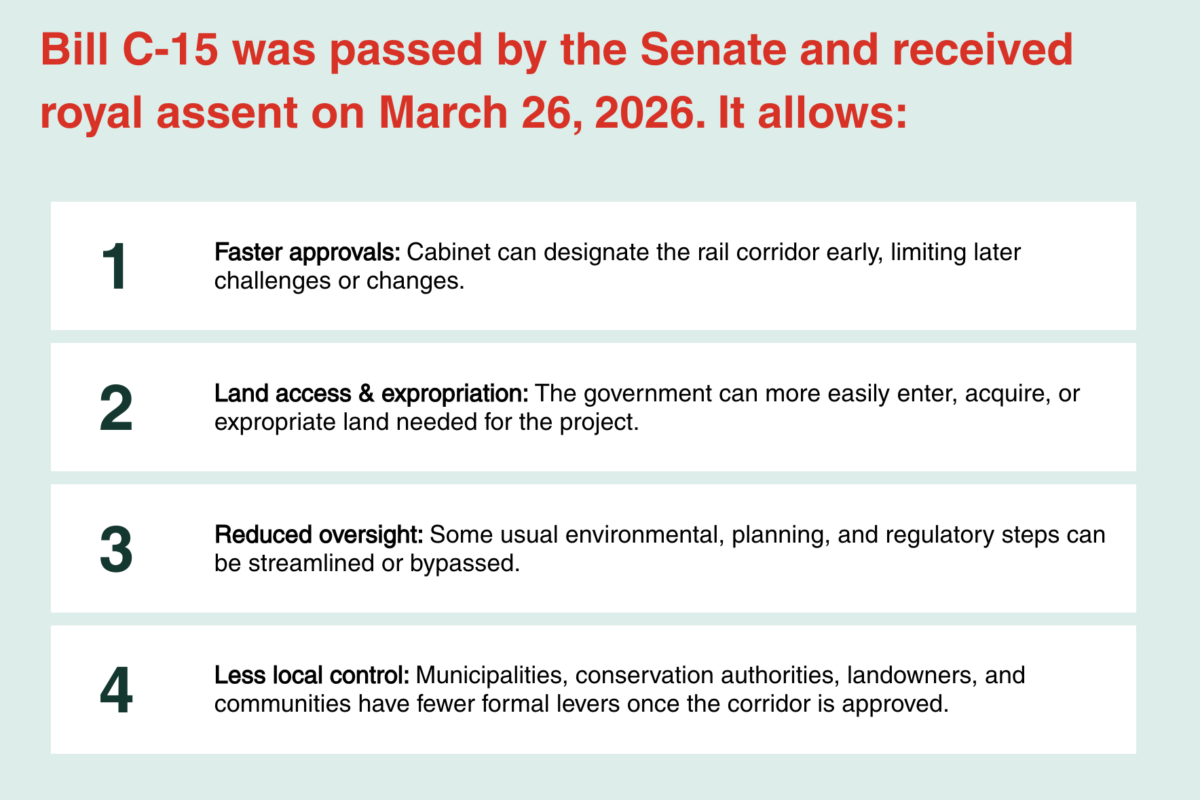
Precision matters more than alarm here. C-15 does not create a government digital dollar. The Bank of Canada shelved its digital currency research in 2024 after a public consultation that drew nearly ninety thousand responses, most of which were opposed. What C-15 does is hand the Bank supervisory authority over privately issued stablecoins, requiring every issuer to register on a Bank-maintained list, and creates a new open banking framework for how your financial data moves between institutions. So the digital dollar everyone fears is not in this bill. But the C.D. Howe Institute is already urging the Bank to revisit digital currency development to integrate with this new stablecoin registry, arguing that technical groundwork already exists. The infrastructure for registered, supervised, and monitorable digital money is being built right now. The foundation poured today is the one the recommendation describes using tomorrow.
C-18 and C-11: Who Decides What You See
The Online News Act required platforms to pay news outlets for linking to their content. Meta’s answer was to block Canadian news entirely on Facebook and Instagram, and it has remained blocked since, leaving local outlets without a major distribution channel and Canadians with reduced visibility into Parliament’s own work. The Online Streaming Act handed the CRTC, a regulator built for broadcast television, new authority over what Canadians see on YouTube and other streaming platforms—through discoverability rules that can influence what gets promoted, buried, or pushed into view. Supporting Canadian content is fair, but the mechanism is a federal regulator with discretion to shape what gets promoted in algorithmic feeds, a power that did not exist a few years ago.
S-209: The Trojan Horse, In Geist’s Own Words
Bill S-209 is sold as a child protection bill, and protecting kids from pornography is something every parent supports. But if a website does not comply with a government notice within 20 days, the agency can obtain a Federal Court order requiring every Canadian internet provider to block that site outright for everyone, not just minors.
Geist, after watching the bill move through committee, called it exactly what it is: a Trojan horse online harms bill, using age verification and court-ordered blocking as its real tools. And once those tools exist, the target does not have to stay pornography. Search engines, social media, and AI services can all be pulled into the same machinery.
How It All Works Together
None of these bills needs a secret architect for the effect to be real. You say something a regulator decides crosses a line, and C-9 plus C-34 give broader grounds to act. C-22’s metadata trail and C-8’s telecom powers make it easier to trace where you said it and who heard it. C-2 and C-12 make it easier to follow your money and hand what they find to other agencies.
The Emergencies Act has already proved that financial access can be cut off by a political decision alone. C-15 builds registry rails that a future government could extend further. C-18 and C-11 shape what gets seen online in the first place. S-209, alongside C-34, normalizes the idea that proving you are not a minor is simply the cost of using the internet. No single piece needs to be sinister on its own. They only need to keep passing while public attention is elsewhere.
So, Where Are We Going, Canada?
The government will say, and on some points genuinely believes, that each bill protects someone: Hate crime victims. Children online. Fraud victims. Critical infrastructure. Voters facing foreign interference in elections. Some of those cases are real and deserve to be heard, because pretending the other side has no argument is its own kind of dishonesty.
But protection and control have always worn nearly identical clothing, and the only thing that has ever told them apart is whether power stayed accountable to people it serves.
Across twelve bills, accountability keeps getting quietly traded away.
Ministerial review removed here. A warrant requirement loosened there. A gag order added over here. A retroactive exemption slipped in over there. None of it loud enough alone to hold a headline for more than a news cycle. All of it loud enough together to change what kind of country this becomes.
You do not lose freedom all at once. It gets built away from you, bill by bill, while you are paying your bills and trusting someone else is watching the door.
The senators who slowed C-4, the lawyers who fought to preserve the religious defence C-9 stripped away, and the privacy advocates still pushing back on C-22 and C-34 right now, none of them waited for permission to pay attention. Neither should the rest of us.
This is not a call to panic. It is a call to wake up, read what is actually being passed in our name, and ask harder questions of people we send to Ottawa. Canada is still ours to shape, but only if enough of us decide, together, that we are done sleepwalking through the bill-by-bill construction of whatever comes next, and start choosing the direction on purpose instead.
Shawn Jason is the creator and Editor-in-Chief of Druthers Newspaper







Explore More...