The-Quiet-Transfer-of-Canada
The Quiet Transfer of Canada
By Shawn Buckley | Substack.com/@ShawnBuckleyLaw
Most Canadians have never heard of UNDRIP, The United Nations Declaration on the Rights of Indigenous Peoples. It is a treaty that the federal government signed on behalf of Canadians without any meaningful public debate, without any referendum, and without any honest disclosure of what it actually obligates Canada to do. What this treaty requires is so consequential that if Canadians understood it clearly, there would be a national conversation that those in power have no interest in.
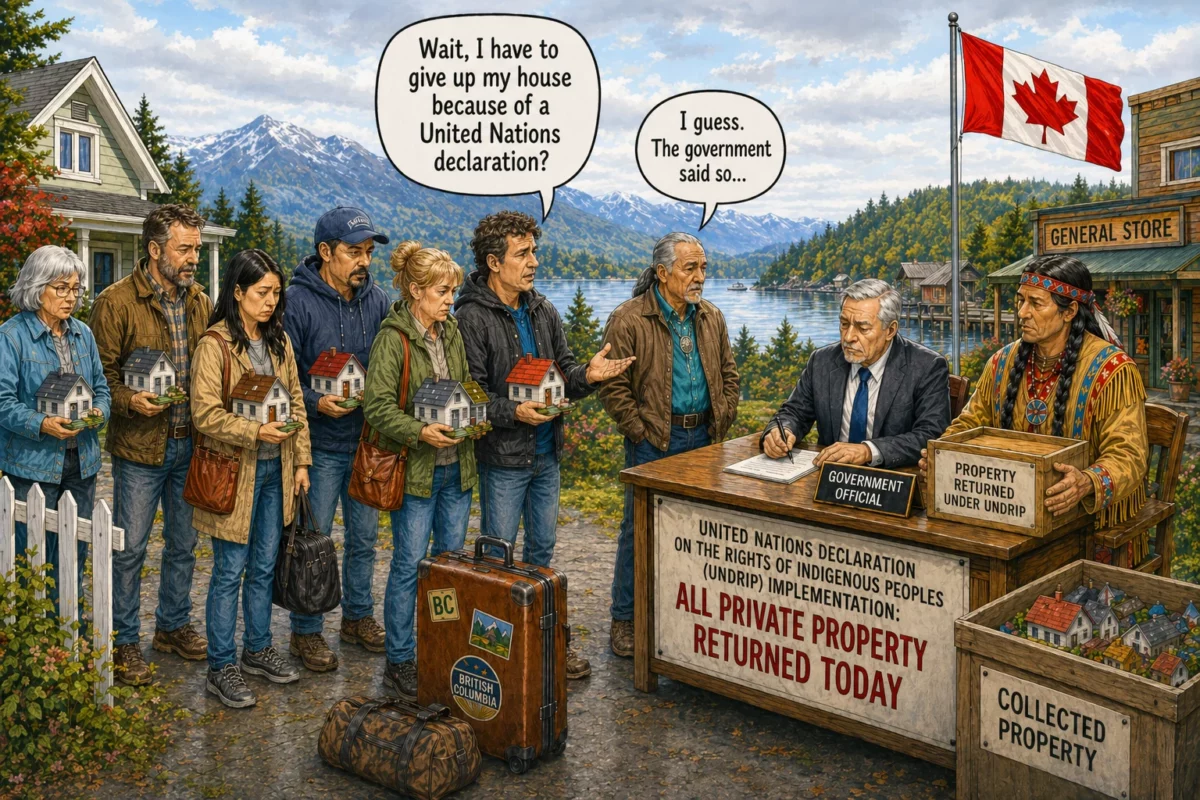
At its core, UNDRIP obligates signatory nations to vest property ownership back into the hands of the Indigenous Peoples who preceded European colonization. In British Columbia, we are already watching this play out in real time. The federal government has moved to transfer land in the Vancouver metro area to the Musqueam Nation. We are talking about a band with fewer than 2,000 members receiving jurisdiction over land that is home to approximately 2 million Canadians. The government has not released the terms of the agreement. Canadians are being asked to accept a seismic shift in property rights without being permitted to read the document that governs it.
To understand why this is happening, you have to understand the legal architecture underneath it. The King of the United Kingdom owns all land in Canada. The King has allodial ownership. Allodial ownership is ownership of land free from a superior landlord. The King owns your land and is your superior landlord. Even when you pay off your mortgage, you do not own your land. What you hold is called a fee simple, which is a grant from the King permitting you to use the land without restriction. The King remains the owner. The King remains your superior landlord.
That is why the King can take your land, such as through expropriation. That is why the King can put restrictions on your land. That is why the King can grant to others property rights to land you think you own, but do not own. UNDRIP is a treaty obligation on the King to transfer ownership of most of our populated areas to Indigenous Peoples.
In 2021, Parliament passed the United Nations Declaration on the Rights of Indigenous Peoples Act. This Act commits the Government of Canada to fully implement the UNDRIP treaty. In other words, this Act legally binds the Government of Canada to transfer ownership of all parts of Canada traditionally used or occupied by Indigenous Peoples to Indigenous Peoples. This is most, or all, of populated Canada.
Article 26 of the UNDRIP treaty reads:
1. Indigenous peoples have the right to the lands, territories and resources which they have traditionally owned, occupied or otherwise used or acquired.
2. Indigenous peoples have the right to own, use, develop and control the lands, territories and resources that they possess by reason of traditional ownership or other traditional occupation or use, as well as those which they have otherwise acquired.
3. States shall give legal recognition and protection to these lands, territories and resources. Such recognition shall be conducted with due respect to the customs, traditions and land tenure systems of the indigenous peoples concerned.
An important point to recognize is that UNDRIP is not limited to unceded land. Many in Canada think that they are safe from having indigenous property rights being imposed on their property because they live where land was ceded by treaty to the King. This is an error. UNDRIP is not restricted to unceded land.
It applies to all land traditionally owned, occupied, or otherwise used by Indigenous Peoples, ceded or unceded. The Government of Canada has committed itself to transferring ownership of most, if not all, of populated Canada.
We can also expect that Courts will start treating ceded land as unceded land. The legal argument that will follow the unceded territory decisions in British Columbia is predictable. The next step will be to challenge the validity of the treaties ceding land to the King.
The argument will be that Indigenous Peoples did not understand the European legal concept of land ownership, that they had no framework for what they were surrendering, and therefore those treaties are invalid. If that argument succeeds, and there is a reasonable legal basis for it, then virtually all of Canada becomes unceded territory subject to the imposition of indigenous title, completely independent of the UNDRIP obligations.
The human consequences of what is already happening in British Columbia are enormous and almost entirely undiscussed. Property owners in the Lower Mainland do not know whether they will be able to refinance their homes. They do not know whether new mortgages will be issued on land whose title is now in legal uncertainty.
They do not know whether the band will lease the land back to them, charge them rent, or eventually require them to leave. Commercial properties face the same uncertainty. The potential financial destabilization this creates for British Columbia, and potentially for Canada as a whole, is staggering. And it was done without a single public vote. It was done in secret.
There is a deeper question worth considering. Even if you accept the premise that the history of colonization was exploitative and that Indigenous Peoples were wronged, the question of remedy still demands honest debate. Is transferring ownership over land that has been “owned” and used in some cases for centuries, an appropriate remedy?
We have built this nation on property rights and ownership. Is it proper to completely undermine this foundation as the remedy? Does this path risk so impoverishing Canada that all of us are much worse off, including the Indigenous Peoples?
What are the consequences for Canada if all property currently owned is transferred to Indigenous Peoples?
These are questions we should be debating.
Why are we not having a public discussion about this? Why is this happening in secret? No party in Parliament is telling us about this issue, which has the potential to reshape this nation more than any other issue.
I’ve been hosting and speaking at events on this topic, helping Canadians understand where their rights are vulnerable and what they can do to protect them.
The best way to stay updated on these topics (or to attend our next in-person event) is to subscribe to my Substack newsletter or follow me on X at x.com/Shawnbuckleylaw
Originally published at substack.com/@shawnbuckleylaw
Shawn Buckley is a Canadian constitutional lawyer (31 years), President, Natural Health Products Protection Association (nhppa.org; charterofhealthfreedom.org), Founding Member and Lead Counsel, nationalcitizensinquiry.ca.


Explore More...