Dont-Railroad-Us
Don’t Railroad Us
High-Speed Rail, Expropriation, and Rural Land Rights
By Stan McDonald
The federal government has announced plans for a high-speed rail corridor linking Quebec City to Toronto, promoted as a “nation-building” project. Behind the glossy language lies a harder legal reality: to build this corridor, governments and railway companies will likely rely on extraordinary expropriation powers to force the transfer of large tracts of privately owned rural and agricultural land. If they can do this to farmers and rural landowners today, they can do it to suburban homeowners tomorrow.
This isn’t just about trains. It’s about turning a transport plan into a forced land-assembly project—a massive land grab. Under Canadian law, expropriation is supposed to be exceptional: the state may take property only for a genuine “public work or other public purpose,” following lawful procedures and with just compensation. Courts have long held that expropriation laws must be strictly construed against the government because taking someone’s land is one of the most serious intrusions the state can make.
This article links the high-speed rail proposal to those legal principles and highlights what rural landowners must insist on before any stakes go in the ground.
Is This About Trains or Land?
Federal law allows the Crown to expropriate land for a “public work or other public purpose.” Railway legislation also lets a railway company that “requires an interest in land” and cannot buy it to ask the federal minister to have the Crown expropriate that land on its behalf. Once the minister decides the land is “required” for the railway, it is treated as if the Crown needs it for a public work.
In other words, a commercial railway can exercise public expropriation powers as long as the project is dressed up as a “public work.” The basic rule is simple: government needs clear, express authority to take property; there is no implied power to seize land merely because it would be convenient.
Key questions for this scheme include:
Is it truly a public work, or mainly a commercial venture that benefits specific corporate interests?
Has government proven that the specific parcels it wants are necessary, and not just “nice to have”?
Are there less intrusive alternatives, like using or improving existing corridors?
If those questions are not honestly answered, the “public purpose” requirement is being stretched beyond breaking.
Ontario’s Process and Shrinking Protections
In Ontario, the Expropriations Act sets out how land can be taken for provincial undertakings or when provincial bodies assist federal projects. Land vests in the expropriating authority only when a formal plan of expropriation is registered in the land registry and all required steps—notice, approvals, and so on—have been followed. If those steps are not followed exactly, the taking is unlawful.
The Act also allows a “hearing of necessity,” in which the authority must show that the taking is fair, sound, and reasonably necessary, that no more land than needed is taken, and that alternatives have been considered. This hearing focuses on necessity, not compensation. It is not automatic; owners must request it in writing within strict deadlines. If landowners do not push for this hearing, a central safeguard is effectively lost. Recent Ontario changes have narrowed the circumstances in which these hearings are available for major transit and infrastructure projects, making it even more important for landowners to demand them wherever they still apply.
Many expropriation programs quietly rely on the fact that most people do not know these rights exist.
Planning Blight and De Facto Expropriation
The high-speed rail corridor is under discussion on a decades-long timeline. Over those years, land can be trapped in “planning blight”: it appears on route maps, is subject to corridor-protection policies, or is informally treated by banks and officials as “already spoken for,” even if no formal expropriation has occurred.
Canada’s top court has confirmed that “de facto expropriation”—expropriation in practice, even if not on paper—can occur where the state effectively gains an advantage from the property and the owner is left with no reasonable or economic use of the land. In a high-speed rail context, this happens when corridor plans and rules make it impossible to expand barns, add drainage, subdivide, build, or refinance because the land lies under the shadow of a future rail line.
You may still hold the deed and pay the taxes, but if government decisions effectively decide that your land’s real function is to be a future rail corridor, the law may regard that as expropriation in everything but name.
A Thin Strip Can Destroy A Whole Farm
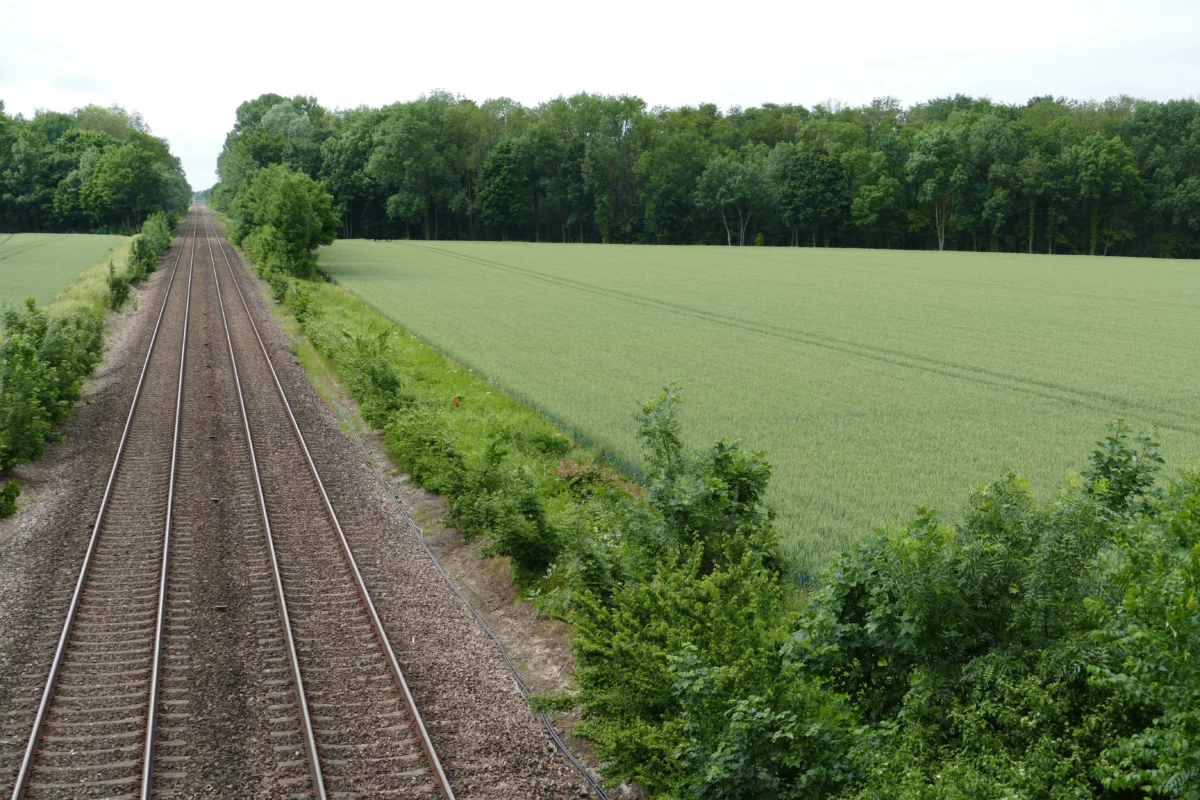
High-speed rail demands wide corridors, buffers, fencing, electrical infrastructure, and permanent maintenance access. Even when the authority takes only a strip on paper, the real-world impact can be far greater:
- Fields severed into awkward, inefficient parcels
- Machinery routes cut, forcing long detours or dangerous road movements
- Livestock movement between pastures blocked or complicated
- Drainage and tile systems cut, increasing flooding and erosion
On paper, you “only lost 10 acres.” In reality, you may have lost a functioning farm, a family operation, and generations of work.
Picture a 300-acre mixed cash-crop farm in eastern Ontario. The corridor cuts diagonally across the farm. Your best tiled field is split in two. The main lane to your back fields is gone, replaced by a narrow, steep underpass that big equipment can barely use. In reality, you lost a functioning farm.
Ontario’s expropriation legislation recognizes “injurious affection”: compensation for damage to the rest of your property, not just the strip taken. In simple terms, if the project reduces the value, usefulness, or income-earning power of the land you still own, you may have a claim. In practice, offers often focus on the strip’s raw value and ignore the loss of a coherent, efficient operation.
Compensation is supposed to put you, as nearly as money can, where you were before. Paying for a few acres while leaving behind a fractured, less viable farm does not meet that standard.
Crossings, Access, and Hidden Harms
High-speed rail systems allow very few level crossings because of speed and safety. If your farm is split by the corridor, you may depend on overpasses or underpasses to move equipment, workers, and animals. The location and design of these crossings will determine whether you can farm the other side.
If crossings are promised but not guaranteed by law or registered on title, they can later be restricted or removed. Where possible, access rights should be tied to the property itself, not just to individual owners, so they survive changes in ownership or policy.
A fenced, electrified corridor—often with high barriers and limited crossing points—can become a hard divide across the landscape. It can create dead-end roads, disrupt traffic patterns, and slow emergency response for fire, medical, or police services. It can also cut off traditional access routes during floods or fires and permanently alter drainage patterns.
Often, these harms appear years after construction, when project teams have moved on.
Environmental and Long-Term Impacts
Beyond property lines, the impacts can extend across entire ecosystems. Corridors can fragment wildlife habitats, disrupt migratory paths, and permanently alter natural landscapes. Changes to drainage can affect rivers, lakes, and underground water systems. Once built, these effects are often irreversible.
At the same time, rural areas bear the burden of operational disruption, long-term land-use constraints, financing uncertainty, succession challenges, and the broader social and mental strain that comes with prolonged uncertainty over land and livelihood.
Consultation: A Real Say or Box-Ticking?
Consultation processes are often presented as opportunities for input, but landowners should ask whether decisions have already been made in substance. Information sessions that present a fixed plan and invite comments on minor details are not meaningful consultation. Without early and genuine input, the only remaining disputes may be about compensation—not whether the project proceeds or how it is designed.
Warning Signs: Start a Paper Trail
Your bank questions loans or refinancing because of the corridor.
Officials say your land is “within the study area” and discourage improvements.
You are told to “wait” on building, expanding, or selling because of potential rail plans.
Government staff or consultants request access to your land for surveys or studies.
You receive any letter, map, or notice referencing your property and the corridor.
These are signals to start documenting everything.
What You Can Do To Oppose This Project
This project will not be stopped by quiet grumbling. It will be stopped, slowed, or reshaped only if people organize and use every legal and political tool available:
- Get informed and organized locally
- Do not sign under pressure
- Insist on formal process and hearings
- Build a paper trail
- Raise the political cost
- Plan for the long haul
If Canada wants fast trains for city commuters, it must stop treating rural landowners as expendable track ballast. The law still offers tools to push back—but they must be used before a single farm is carved up.
Stan McDonald is a Canadian entrepreneur and metalworker focused on legal reform, public discourse, and property rights. He writes on sovereignty, government accountability, and small business solutions.








Explore More...