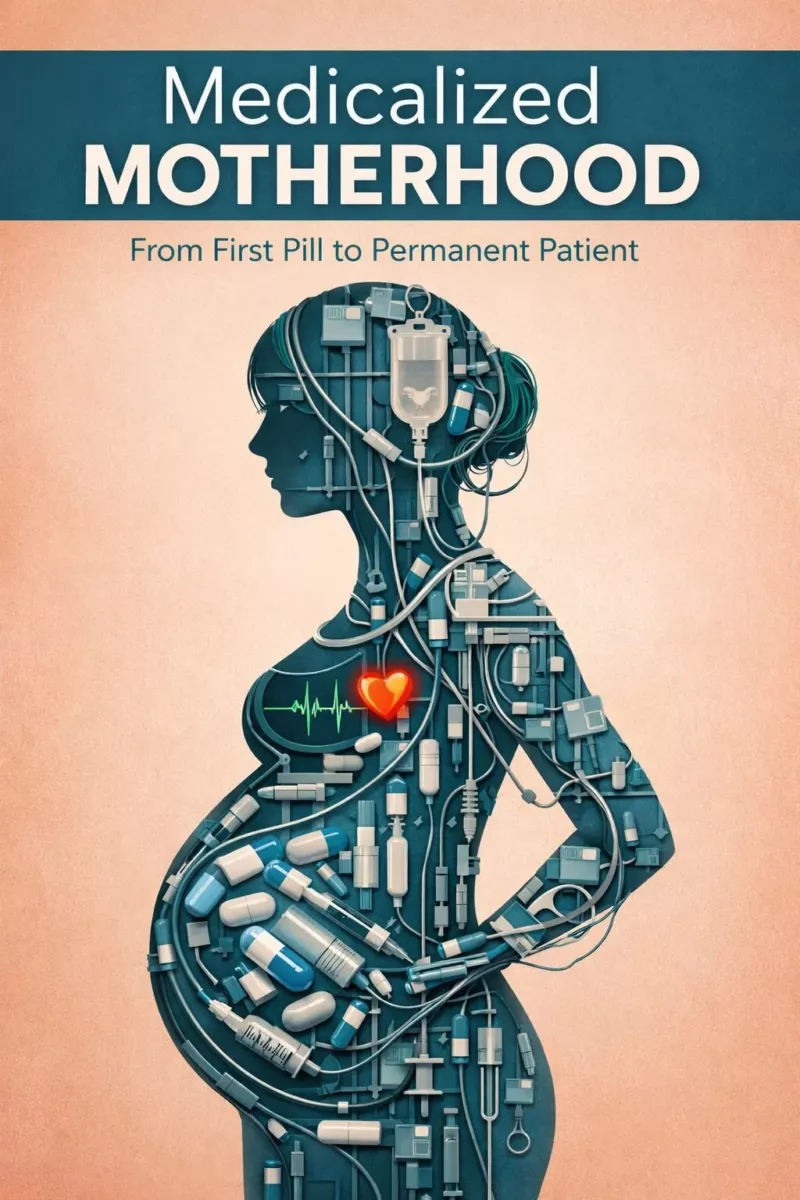
Medicalized-Motherhood-From-First-Pill-to-Permanent-Patient
Download this book for free at Substack.com/@Unbekcoming
Medicalized Motherhood: From First Pill to Permanent Patient
Editor’s Note: The following piece is written by the author and serves as an overview of the book’s themes and findings. The full work is published independently and available for free download at Substack.com/@Unbekcoming.
By Unbekoming
In 1975, a Baltimore gynecologist admitted to the New York Times: “Some of us aren’t making a living, so out comes a uterus or two each month to pay for the rent.”
A doctor, on the record, explaining why he removes women’s organs. Not because they’re diseased. Because he needs the income.
I encountered that quote in Robert Mendelsohn’s Male Practice, one of two books that changed how I understood medicine’s relationship with women. The other was Nora Coffey’s The H Word, which documented what happened when the HERS Foundation gave over 5,000 women—whose doctors had recommended hysterectomy—access to second opinions. Only 2% proceeded with the surgery. Ninety-eight percent of those hysterectomies were unnecessary.
The pattern Coffey documented—one intervention creating conditions for the next—was the same pattern I later recognized in Dr. Amandha Dawn Vollmer’s1 work on obstetrics. Modern obstetrics doesn’t rescue women from dangerous births. It creates the dangers, then takes credit for the rescue.
I started documenting interventions. Twenty-two seemed comprehensive. Then readers wrote in with practices I’d missed—the membrane sweep performed without asking, the “just in case” IV that led to the epidural that led to the cesarean. The list grew to thirty-six, then fifty-five, then seventy-one. By the time I’d finished an eight-part series, I’d documented 118 interventions spanning pre-conception through postpartum. This edition adds five more—interventions that emerged from continued research after the original series—bringing the total to 123.
The scope surprised me. I expected unnecessary procedures clustered around labor and delivery. I didn’t expect to trace the capture back to a teenage girl’s first birth control prescription, or forward to postpartum surveillance that transforms new mothers into permanent patients.
Don’t lose touch with uncensored news! Join our mailing list today.
The cascade runs longer than anyone admits. And it runs in one direction: toward dependency.
What’s in the Book
Medicalized Motherhood: From First Pill to Permanent Patient2 reorganizes that material chronologically, following a woman from before conception through her first year as a mother. The sequence matters. Interventions that seem isolated reveal their connections when placed in order. The fertility app leads to the optimization protocol leads to the IVF cycle leads to the high-risk label leads to the induction leads to the cesarean. Each phase prepares the ground for the next.
The Six Phases
Phase One: Before the Beginning—From birth control’s legacy effects through fertility optimization, AMH testing, egg freezing, and IVF. How the system captures women before conception.
Phase Two: The Pregnant Patient—Ultrasounds, due dates, the “advanced maternal age” label, gestational diabetes testing, genetic screening, prenatal mental health screening, vaccines, and the pharmaceuticals prescribed to manage the anxiety the system created.
Phase Three: The Machinery of Birth—Membrane sweeps, induction, cervical ripening, artificial rupture of membranes, continuous monitoring, Pitocin, epidurals, “failure to progress,” lithotomy position, episiotomy, forceps, vacuum, cesarean. The cascade in its most concentrated form.
Phase Four: The First Hours—Immediate cord clamping, suctioning, mother-baby separation, routine bathing, Vitamin K, hepatitis B vaccine, eye prophylaxis, circumcision, newborn screening. How the system claims the baby.
Phase Five: The First Year—Weight loss panic, formula supplementation, breastfeeding sabotage, tongue-tie diagnosis, reflux medication, well-baby visits, growth chart anxiety, developmental milestones, sleep training. The infant as patient.
Phase Six: The Mother Who Remains—Postpartum surveillance, mental health screening, medication, birth trauma, and the transformation of a healthy woman into a permanent patient.
The book documents 123 interventions across six phases, with two synthesis chapters explaining the business model (“The Newborn as Revenue Stream”) and the ultimate outcome (“The Manufactured Incompetence of Mothers”).
Five interventions are new to this edition, filling gaps in the cascade:
AMH testing, which sells fertility anxiety through numbers that don’t predict natural conception; cervical length screening, which converts normal variation into high-risk pregnancy; the admission monitoring strip, which initiates the labour surveillance cascade; newborn sepsis workups, where maternal interventions create newborn patients; and the lactation consultant industry, which professionalized knowledge that once passed freely between women.
One chapter is entirely new. “Reclaiming the Birth” did not appear in the original series. Readers asked the question the series left unanswered: now what? Understanding the cascade is necessary but not sufficient. The woman facing an induction recommendation next week needs more than analysis—she needs questions to ask, language to use, a framework for deciding. That chapter provides tools for interrupting the cascade: three questions that create space for decision-making, language for declining, and guidance for distinguishing genuine emergencies from manufactured urgency.
Practical Tools
The book includes appendices designed for real-world use:
- Birth Plan Template—Organized by phase, documenting your preferences in language providers recognize.
- Questions Checklist—A quick reference for the laboring woman and her support person. The three questions, phrases that preserve options, how to distinguish emergency from manufactured urgency.
- Provider Interview Questions — A guide for choosing a provider before the cascade begins. The questions that reveal actual practice patterns, not marketing language. Red flags and green flags. Because switching providers at eight weeks is simple; switching at thirty-eight weeks is not.
- Quick Reference Card—A single page to print, laminate, and bring with you. The essential framework when you can’t think clearly.
- After the Cascade—For women reading this after a birth that didn’t go as hoped. What happened was not your fault. Resources for processing birth trauma, information on VBAC, and a path forward.
- The Cascade: A Visual Map—Four diagrams showing how interventions connect. The labour cascade, the newborn cascade, the breastfeeding cascade, the pre-conception cascade. Sometimes seeing it changes everything.
- International Notes—How the cascade operates in the UK, Australia, Canada, and beyond. What’s universal, what differs, and resources for readers outside the United States.
From the Archive
A final section—“From the Lies Are Unbekoming Archive”—collects many related pieces from my Substack: interviews with practitioners who’ve rejected the medical model (Dr. Stuart Fischbein, midwife Salli Gonzalez, Christiane Northrup, MD,3 Laura Shanley on unassisted birth), summaries of books that shaped this work (Ina May Gaskin, Jennifer Margulis,4 Dr. Amandha Dawn Vollmer), and a birth story from a close friend who applied these principles at Royal Women’s Hospital (Australia).
Why Free?
This information belongs in the hands of every woman entering the system—and every partner, mother, sister, or friend supporting her. The cascade works because women don’t know they can interrupt it. A book sitting behind a paywall doesn’t reach the twenty-two-year-old whose doctor just scheduled her induction for “convenience.”
Download it. Read it. Share it with someone who needs it.
The woman who understands how the cascade works can make different choices. That possibility is why this book exists.
- substack.com/@amandhavollmer
- substack.com/@unbekoming
- substack.com/@truenorthdr
- substack.com/@jennifermargulis
Originally published at substack.com/@unbekoming







Explore More...