Grounded-By-The-Jab
Image via ChildrensHealthDefense.org
Grounded by The Jab
A Pilot’s Story of Survival
By Tim McAdams
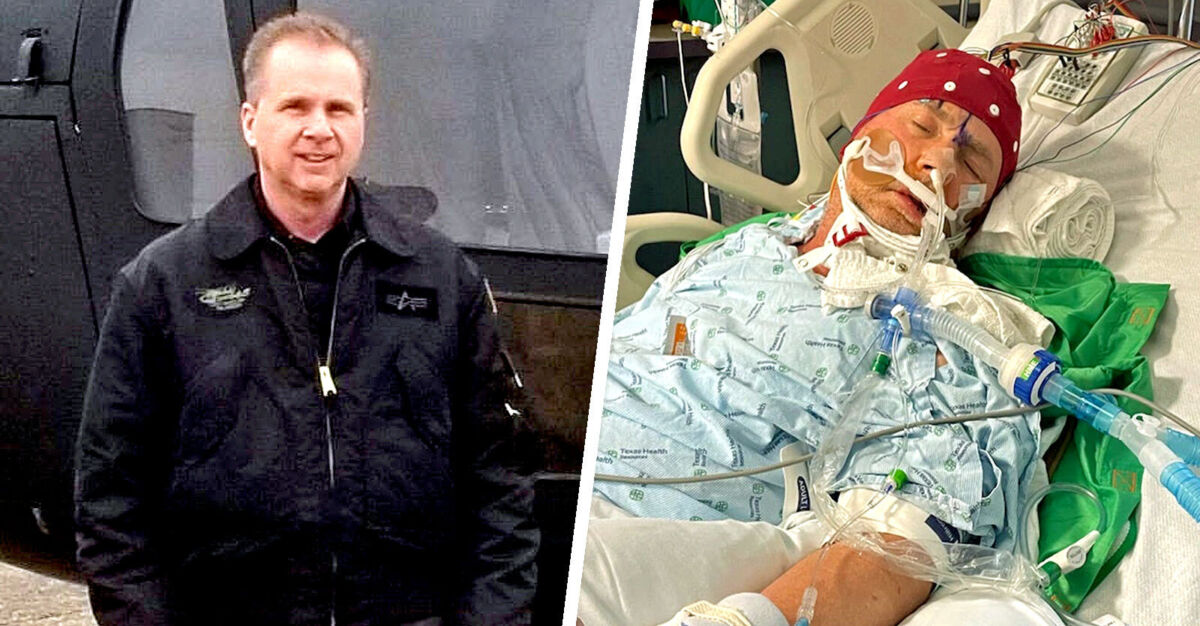
In November 2021, I was a 59-year-old male who never smoked, didn’t drink, and exercised five to six times per week. I was a 40-year career pilot in excellent shape, with no prior medical issues or pre-existing conditions. Doctors later agreed that one of the main reasons I survived the devastating strokes and serious complications that followed—including emergency brain surgery—was my good health.
I did not want or need the risky COVID shot, but I took it after my company threatened to fire me. I was afraid of losing my ability to support my family.
I received my second Pfizer-BioNTech COVID-19 shot on November 7, 2021.
During the night of November 28, I suffered the first of two strokes. Around 1 a.m., I woke up dizzy, throwing up, and having difficulty moving my legs. My wife took me to a local emergency care hospital, where I was diagnosed with vertigo, given anti-nausea medication, and sent home that morning feeling okay.
The following night, it happened again. We returned to the same emergency hospital, where they did a CT scan of my head and said it was clear, with no sign of a stroke. They had no overnight beds and wanted to send me by ambulance on a two-hour trip to their main hospital for observation.
That didn’t make sense to me. We live in the Dallas–Fort Worth area, which is home to dozens of good hospitals. I believe I was a well-insured patient, and they wanted to keep me in their system. I checked out, went home, and my wife called 911.
An ambulance from the local fire department transported me to a larger hospital near my house. There, more tests were done, and the doctor informed me that I had suffered two very rare bilateral cerebellar strokes. I was told I needed to stay in the hospital for observation.
That same evening, I was transferred to another hospital in Fort Worth, Texas, because they had a vascular surgeon on call. The next morning, I collapsed, unable to speak or move. An emergency head CT confirmed that my brain was swelling due to water on the brain. Over the next few days, I was given a solution to reduce the swelling and was closely monitored in the neuro ICU.
On December 4, the solution must have been losing effectiveness, and I was rushed into the operating room for emergency brain surgery. A drain was placed on the side of my head, and I underwent an emergency decompressive craniectomy to relieve the pressure and allow my swelling brain room to expand.
While in the ICU, I developed double pneumonia. After multiple intubations and extubations, I could not breathe on my own. Fearing the breathing tube had been in too long, doctors performed a tracheostomy to protect my airway until I could breathe independently. One of my vocal cords was permanently damaged. Because I also had difficulty swallowing, doctors placed a feeding tube in my stomach.
Once everything was under control, I was transferred to a long-term acute care hospital, where they started getting me out of bed and I gradually improved. It was there that I began to have a clearer understanding of what had happened.
One conversation from that time has stayed with me.
Toward the end of my hospital stay, a nurse was adjusting my IV when a doctor came into my room with the results of a recent test. He said the results were unremarkable, and they still had no clear reason for the strokes. I was frustrated and asked him what he thought had caused them.
He asked if anything unusual had happened to me in the previous three months, such as getting hit on the back of the head. I said no—the only thing different in my life was the COVID vaccine. He replied, “Oh, that would have nothing to do with your strokes,” and left the room.
The nurse had paused while the doctor was in the room. After he left, she turned to me and said, “For political reasons, you will never get a doctor associated with this hospital to admit that the COVID vaccine has any negative side effects. I think the COVID vaccine had everything to do with your strokes.”
She then encouraged me to file a report with VAERS—the Vaccine Adverse Event Reporting System—a U.S. system where doctors, nurses, patients, and families can report adverse events that happen after vaccination. I had never heard of VAERS before that moment, but when I got out of the hospital, I filed a report.
That is when I started connecting the dots.
I was later transferred to an inpatient rehabilitation hospital. There, I was able to get out of a wheelchair and use a walker. After that came outpatient rehabilitation, where I was finally able to walk again.
I spent the first year after leaving rehab trying to regain my balance, strength, and endurance. Some of it returned. Doctors told me I would likely make progress for about a year, and then my recovery would slow or stop and remain that way for the rest of my life. I stopped improving pretty close to their prediction.
The toll on me and my family has been extensive.
I am now seeing my long-time doctor of more than 20 years for follow-up care. After more than a year of examining me after the strokes and reviewing my medical records, he determined that the COVID-19 vaccine caused my strokes. I am intentionally omitting his name because many doctors who have challenged Big Pharma’s “safe and effective” narrative have had their medical licenses threatened. His diagnosis was written in my medical notes in January 2024.
I was told by many doctors and nurses that I was lucky to survive. Most people who suffer this type of stroke and go through this kind of ordeal don’t make it. In total, I spent 80 days in the hospital recovering from two strokes and multiple life-threatening complications, including emergency brain surgery and double pneumonia.
I wasn’t expected to live, but I did. I decided to tell my story because I want others to understand what can happen when people are pressured to put an unknown, unproven, and experimental substance into their bodies. If you are lucky enough to survive—and many were not—your life and career can still be permanently altered.
When I was finally released from the hospital, I required a great deal of care. Since she could not work from home, my wife resigned from her job to care for me.
Following extensive rehabilitation, I eventually learned to walk on my own, swallow, and drive a car with restrictions—no night driving, no bad weather, no heavy traffic, and so on. But I could no longer pilot an aircraft. These COVID-19 vaccine injuries caused me to lose the medical certification required to fly.
After a 40-year career, my ability to work as a pilot was gone. With my career ruined and my wife forced to leave her job to care for me, we now survive on a disability payment. We were forced into retirement about six years earlier than planned.
Although we have had to make many adjustments, we are surviving okay. When we see what other vaccine-injured people are dealing with, we view our sacrifices as minor.
I do physical therapy every day in an attempt to regain strength and improve my balance. I also post daily on X, sharing images of myself in the hospital to help others better understand the risks: @covidjabstroke.
Our mission now is to raise awareness and help others make informed decisions.
Most days, I think about the horrible COVID-19 mandates that so many people were threatened into accepting without informed consent, and it saddens me.
Beyond what happened to me personally, I believe this raises a serious public-safety issue for pilots.
My former employer did not have authority to regulate pilot medical standards. That authority belongs to the Federal Aviation Administration, which demands the highest level of health from pilots trusted with many lives.
I believe that, by threatening a risky medical treatment for an otherwise healthy pilot—a treatment not required for pilot medical certification or air safety—my employer’s actions rendered me physically and legally unable to perform my duties, thus gravely endangering the public.


Explore More...