The-Allison-Inquiry-and-the-Antosovetchik-Lesson
The Allison Inquiry and the “Antisovetchik” Lesson:
First Label Them, Then Ignore Them
By DG | substack.com/@ivim
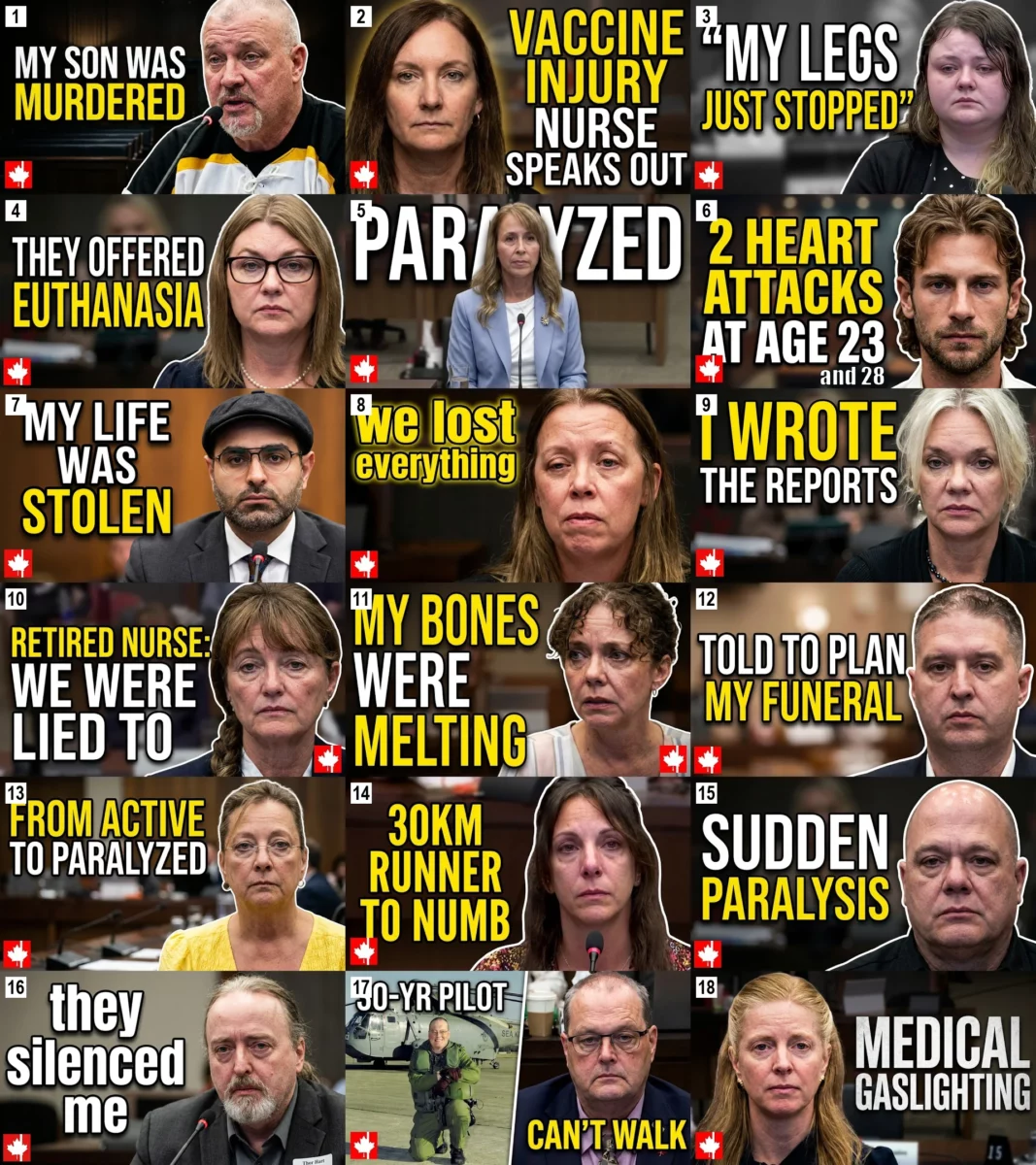
From September 8–11, 2026, the Allison Inquiry heard four days of testimony on Parliament Hill from Canadians describing injuries and losses they attribute to COVID-19 vaccination, together with physicians, researchers and others examining different aspects of the pandemic response. For many of those who watched it, the testimony was difficult to hear.
Almost immediately, I began seeing the hopeful reactions: Will this finally change something? Will CBC and other mainstream media finally start talking about it? Has the Allison Inquiry planted the seed for accountability—and some hope for people who believe they were injured by the vaccines or mandates?
Perhaps. But I think we need to prepare ourselves for another possibility: None of that may happen automatically. And the reason is something that people who grew up in the Soviet Union, like myself, may recognize particularly well.
A Label That Ends the Conversation
There was a word in Russian: антисоветчик—antisovetchik, or “anti-Soviet.” It was more than simply a description of someone’s political views. Soviet law prohibited forms of “anti-Soviet agitation and propaganda,” while the state maintained extensive control over publishing, newspapers and other means of public communication.
Once someone was placed into that category, the substance of what the person was saying could become almost irrelevant. You did not need to debate him. You did not need to disprove him. You could simply classify him. And once classified, he could largely disappear from normal public discourse.
How Information Disappears
Consider Aleksandr Solzhenitsyn, who documented the Soviet prison-camp system and received the 1970 Nobel Prize in Literature. His writings became some of the best-known literary documentation of Soviet repression. Yet much of the information represented by writers like Solzhenitsyn circulated through unofficial channels rather than government-approved Soviet publishing.
One of the most important words for understanding this world is samizdat—the underground copying and circulation of material that could not pass through official Soviet publishing. These people eventually became world-famous. But that does not mean the average Soviet citizen could easily read what they had actually written or even understand why they mattered.
There was no Internet. Television, newspapers and publishing were controlled. If the official information system decided that someone should not exist in normal public conversation, that person—and, more importantly, the information associated with that person—could effectively disappear for millions of people.
The Mechanism I Recognize
I am not saying that present-day Canada is the Soviet Union, or that consequences faced by Canadian dissenters are equivalent to Soviet imprisonment, psychiatric confinement or forced exile. They are not. The parallel I see is narrower—and precisely for that reason, important.
It is the mechanism of: label first, examine later—or never.
In the Soviet Union, one of those labels was antisovetchik. Today, on questions surrounding COVID policy, one of the most powerful labels has been: “anti-vaxxer.”
Once that label is attached, an extraordinary thing can happen. A scientist can become an “anti-vaxxer.” A physician can become an “anti-vaxxer.” A person describing an injury can become an “anti-vaxxer.” A public servant examining official government statistics can become an “anti-vaxxer.”
And then the label itself begins replacing examination of what that person actually said. That is the part that concerns me most.
When Evidence Is Politically Invisible
I work inside the Government of Canada. I talk to other public servants. And one of the things that strikes me is how many people around me have no idea what the Allison Inquiry is, who testified there, or what was presented.
That observation matters. Because an inquiry can produce dozens of hours of testimony. Researchers can prepare analyses. Injured people can tell extraordinarily difficult stories. Documents and videos can be placed online. And yet almost all of it can remain outside the information environment inhabited by millions of Canadians.
This is why I do not think our strategy can simply be: “Wait until CBC covers it.”
Whether CBC, another major broadcaster, a government department, a professional association or some other institution eventually decides to engage seriously with this evidence is not something we control. And waiting for institutional permission to discuss documented evidence is precisely the wrong lesson to take from the Soviet experience.
Document the Evidence
If testimony is important, preserve it. If documents support it, archive them. If datasets exist, analyze them. If claims can be tested, test them. If evidence contradicts other evidence, preserve both and make the disagreement visible.
Most importantly, organize the information so that someone encountering the issue five years from now can reconstruct what happened without depending on today’s social-media algorithms.
That is where I believe I can contribute. My professional background is in AI, data science, computer vision and data engineering. Evidence sitting in thousands of PDFs and videos is not yet a knowledge base. We need to turn it into one.
Bring the Evidence Inside
There is another step which I believe is equally important. Public servants should not assume that an issue can only be discussed after senior management, government communications or national media have declared it acceptable.
There are already mechanisms within the public service designed to identify risks, workplace problems, and systemic concerns. Depending on the issue, these may include occupational health and safety committees; disability and accessibility committees; scientific integrity and professional forums; union structures; workplace consultations; departmental data and research communities; and other internal mechanisms intended to surface problems before they become larger ones.
If evidence presented at the Allison Inquiry has implications for workplace health, disability, accommodation, scientific integrity, fear of reprisal or the treatment of public servants affected by mandates, then these are legitimate places to begin asking questions.
Not shouting. Not accusing. Asking. Documenting. Analyzing. That is much harder to silence.
Tools the Soviet Dissidents Never Had
This is perhaps the most important difference between their world and ours. We have the Internet.
We have Freedom of Information and Access to Information laws. We have open government datasets. We have inexpensive storage. We have open-source software. We have AI. We can build databases that would once have required an entire institution. And thousands of ordinary people can collaboratively preserve evidence that previously could have disappeared with one editorial decision.
That is why I am building tools such as the FOI-ATI Evidence Commons—to archive and make Freedom of Information and Access to Information responses searchable and reusable.
I am also developing iTrack PSES, which uses Public Service Employee Survey data to automatically identify organizational red flags—including unusually poor results related to fear of reprisal, ethics and other workplace indicators—and allows those patterns to be examined over time and across organizations.
These are not merely websites. They are attempts to build an institutional memory outside institutional gatekeeping.
What to Watch
All four days are now available through the Allison Inquiry recordings. My first recommendation is the first half of Day 1. If you watch nothing else, start there.
The proceedings begin by setting the framework for the Inquiry and then move to the testimony of US Senator Ron Johnson of Wisconsin, Chairman of the US Senate Permanent Subcommittee on Investigations. For me, Senator Johnson’s appearance is particularly important because it demonstrates something beyond the vaccine debate itself: what elected officials can actually do when they decide to investigate rather than simply accept what institutions tell them.
And perhaps most importantly: listen directly to the Canadians describing what happened to them.
Whether one ultimately accepts every proposed causal explanation or not, these testimonies are now part of the public record. They deserve to be heard, documented and examined rather than reduced to a label.
From Evidence to Action
This Substack—IVIM—is primarily where I will continue documenting the evidence. My complementary DG4VP Substack focuses more directly on action: what professionals, public servants and Professional Institute of the Public Service of Canada (PIPSC) members can actually do with that evidence, and the tools and initiatives I am developing to support them.
So if you followed the Allison Inquiry and found yourself asking, “What do we do now?” My answer is: Do not wait for someone else to legitimize what you have seen.
Document it. Archive it. Organize it. Make it searchable. Bring legitimate questions into the professional and institutional mechanisms that already exist. And help others do the same.
Because perhaps the most important lesson from the Soviet antisovetchik experience is not simply that censorship existed. It is that censorship worked best when ordinary people came to believe that something which was absent from official media was therefore unworthy of discussion.
Today we have tools that Soviet citizens could scarcely have imagined. The question is whether we will actually use them.
Read the full article at substack.com/@ivim





Explore More...