My-Line-in-the-Sand-with-AI
My Line in the Sand with AI
By Julie Dee
A few minutes into the Lucy Letby documentary the other day, I spotted a small disclaimer in the top corner of the screen. The woman before me, it transpired, was not a woman at all. I was viewing someone—something—that had been digitally anonymized.
Hang on … I thought. So this grieving parent I’m watching isn’t really a grieving parent? Hm … tough call. Because the words spoken were indeed a mother’s own words. But the voice wasn’t hers. Nor was the face.
Bloody hell! It felt like new, uncharted territory—an alarming hybrid. “Chill,” said Netflix, in the voice in my head, as though it understood my hesitancy. “No! Sorry! I just can’t!” piped up my ever-louder intuition. This was like a white Creme Egg—I just couldn’t bring myself to go there!
Disgusted and a little confused as to why, I switched off. As I did so, I began questioning my own thought process and reasoning. After all, for years we’ve been subjected to witness accounts being anonymized—the obscured figure in a chair, the weird voice distortions. So why did this feel different? Ickier?
“They do it on YouTube adverts all the time,” said a friend. But this particular TV offering wasn’t attempting to sell me a product. It invited me to consider the deaths of real babies. That surely mattered more. I was being asked to feel empathy for helpless infants by means of connecting with … what exactly? It certainly wasn’t an entire human being, rather fragments of one.
“But cartoons aren’t real,” said my logical brain, as I remembered myself crying at the end of The Fox and the Hound. “And actors aren’t really experiencing things in films. They are portrayals.” But this was different. It wasn’t so obviously fake as an animated fox. Nor did it profess to be a dramatization of events. It amounted to mixed messages of the highest order.
It dawned on me that I was asking my mind to perform a new type of task, against its better judgment. To recalibrate the way my senses communicated with my brain in order to understand something. To reconfigure my settings. It felt like I was training myself in self-deception, and I didn’t like it one little bit.
It presented as a test. “Will you accept that?” said the television, like a mother concealing a diced courgette inside a spag bol. “I won’t!” I protested, stubbornly.
Because what happens when we keep indulging these crude mash-ups too often? Doing the red light, green light shit? What occurs when we grow indifferent to the ever-expanding quantities of fake being smuggled in amongst the real?
Our intuition is undermined. A natural predisposition, and collective genetic memory honed over centuries, is disrupted. We are rewired, rerouted. Compromised and vulnerable.
Maybe this sounds a little melodramatic. After all, acceptance of the artificial is nothing new. Artificial flavourings, for example, have long tried to convince us an unnatural foodstuff is strawberry or banana flavour, even though it may have never been near an actual piece of fruit in its manufactured life.
At other times, we are tricked into thinking food is close by by means of fragrance. Anyone who has seen Heretic will recall the unsettling blueberry pie scene.
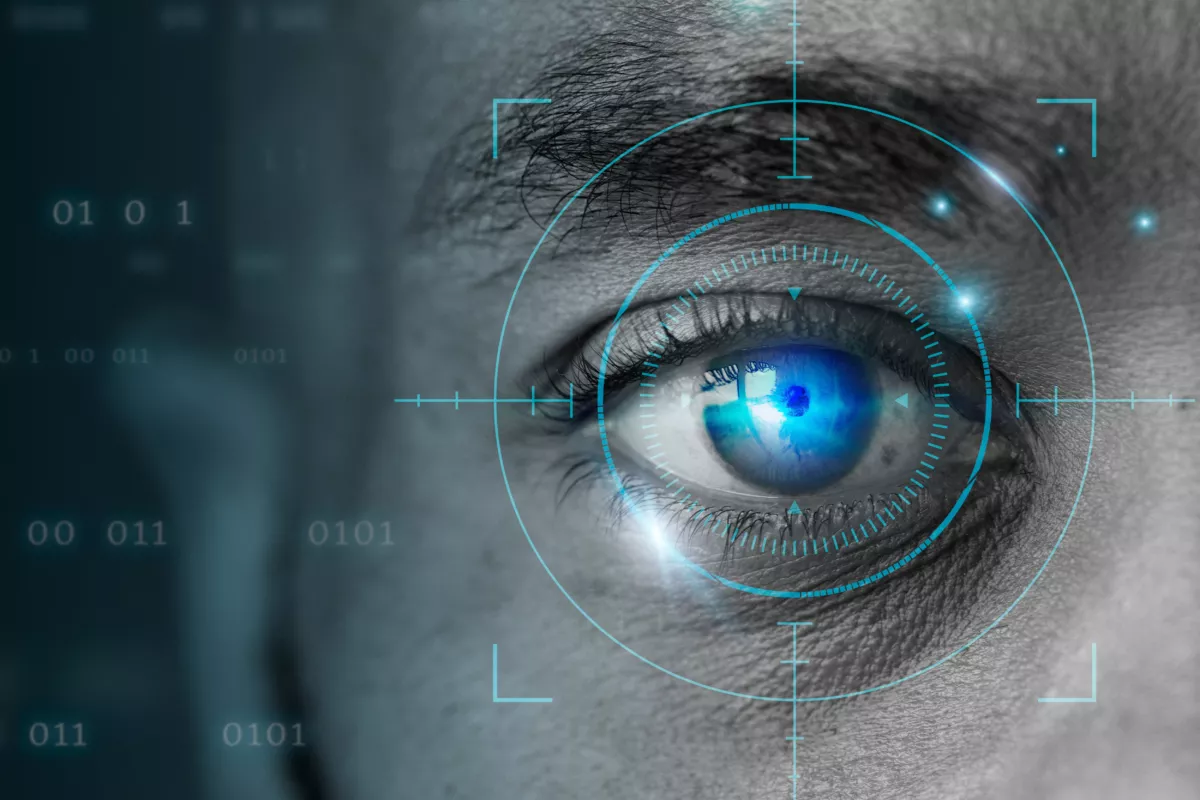
But somehow, for me, human faces—particularly eyes—feel like a final frontier, a last bastion.
I watched the 1960 film Les yeux sans visage earlier this year. An incredible movie that, amongst other things, highlights the significance of eyes—the power they hold over us. We gauge so much from them—the dilation of pupils, the way they widen in fear or disbelief, their ability to produce tears. Conversely, we identify some people as being dead in the eyes, and that unnerves or concerns us. They give someone away. “I can always tell by your eyes,” “look me in the eye,” we say. These are phrases that have come to be associated with assessing character and motive.
It’s no accident that people with visual impairments have guide dogs to be their eyes, not a robot. And I expect that most prefer it that way.
The make-up of a living being is designed to weigh up situations as a whole, to consider how cues and clues fit together. The senses work in sync.
And yes, I know we’ve been watching computerized images on TV for years. I’m old enough to remember Max Headroom! But I looked at Max, knowing he wasn’t real. Channel 4 wasn’t trying to convince me that he was.
The new generation of tech, however, readily invites us to conflate fact and fiction. The clumsy stitches that once separated reality and fantasy are now seamless.
Hand and glove are no longer hand in glove. The glove is the hand, and the hand is the glove.
Developments such as brain chipping mean it’s not just a case of what we see, but also what is allowed inside the sanctity of the human body.
Tech is no longer treated as a separate entity. We are being asked to absorb it, to have it enter us, both energetically and physically.
Coming back to eyes and faces, there’s something at the core of us that knows we weren’t made to interact with soulless eyes. We feel duped, empty, and short-changed.
What happens when we ignore this red flag? When we start habitually looking into the eyes of computer creations and emoting as though they are real?
“Look into my eyes, look into my eyes, the eyes, the eyes, not around the eyes, don’t look around my eyes, look into my eyes,” said Kenny Craig, the hapless hypnotist played by Matt Lucas in the 00s show Little Britain.
It was a parody based on a simple truth—eyes really can and do hold influence over us.
If eyes truly are the windows to the soul, then what, energetically, are these AI eyes, these hugely inferior substitutes we are being asked to peer into and connect with? How could this be weaponized by those with dubious intentions?
“That’s my line in the sand,” people often say when faced with something that seems a bridge too far. But our capacity to discern this is being systematically eroded.
The sand is no longer wet, the line not easily recognizable. The line has morphed into a sidewinder—a deceptive snake that mimics its environment whilst subtly nudging us to follow it elsewhere.
Human weaknesses are being exploited—be they vanity, in the form of beauty filters; laziness, in the form of response suggestions; or our appetite for ever more amusing entertainment, in the form of spoof videos.
Sands are shifting.
What happens when, collectively, humanity chooses to override its default settings—settings that have evolved to protect us from danger?
My gut tells me that our senses will not just become confused and desensitized but also made susceptible to programming and hijacking.
We cannot allow ourselves to be hypnotized and sleepwalk into further cognitive dissonance.
So much is made of being awake, opening our eyes to things. But sometimes, opening our eyes is about knowing when to close them, too.
Originally posted at facebook.com/1GEV614gMY







Explore More...