The-Battle-of-Billings-Bridge
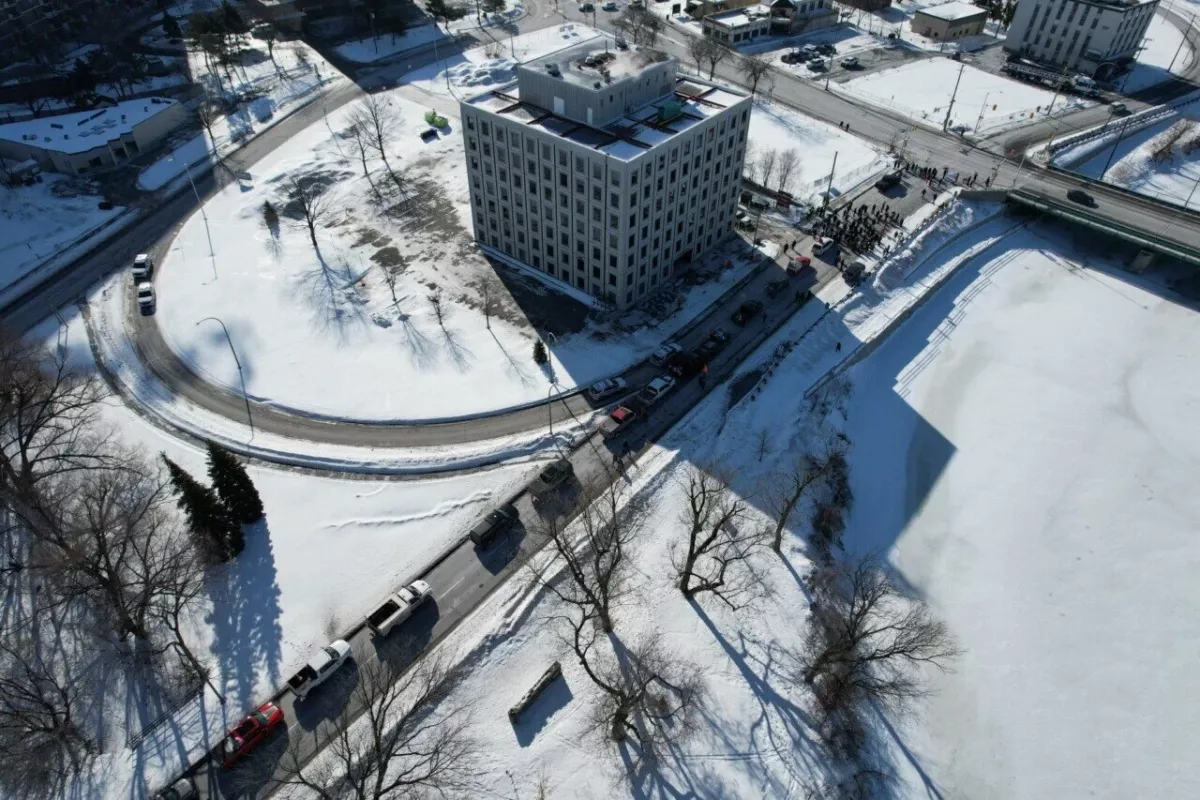
February 13, 2022 - Billings Bridge, Ottawa, ON (image submitted by the author)
The Battle of Billings Bridge
By Deidter Stadnyk
It’s a shame to forget the lessons learned from the past. So every February, I take time to reflect on my time in Ottawa. The legacy of the Freedom Convoy serves as a lesson in the power of humanity when people work together to achieve a goal. Prominent in my memory is the day that Ottawa residents banded together to blockade a mini-convoy from reaching downtown. It has been coined “The Battle of Billings Bridge.”
That’s right, a full-on “battle.” I found this out myself while researching Freedom Convoy history last year. There are multiple articles and blog posts about it, a song on Spotify, branded merchandise, and even a historical plaque commemorating the event in the Canadian Museum of History.
But history is written by the victors, so in this battle the word “convoy” is associated not with “freedom,” but rather “fascism.” To Ottawa residents, The Battle of Billings Bridge is hailed as the day they sent us “occupiers” back to where we came from. While I concede the victory, I resent the bias. So today’s history lesson comes from me, the loser. I hope you enjoy.
It was a cold Sunday morning in Ottawa, February 13th, 2022. I’d just been relieved from nighttime sentry duty at Basecamp Coventry, the Freedom Convoy’s logistical headquarters. By the time the sun was up, I had a hankering for hot food before I could collapse in my makeshift bed at the International Revival Church. MPP Randy Hillier was hosting a pancake breakfast downtown, so I joined a couple dozen vehicles heading to the city’s core.
We drove down Riverside Drive, flags flying proudly in the frosty air, approaching our turn at Bank Street. The traffic slowed, came to a stop, and police cars blocked us from behind at Neil Way. I opened the door and stood up on the truck running board. I could just make out flashing police lights and a throng of people. My pancake run was about to get a lot, lot longer.
We were cut off.
Groups of protesters with signs like “Go Home Freedumb Convoy!” worked their way down the line of stranded vehicles. I could tell we were not among friends. Yet in the space between the mask and the toque, there was a familiar look. Inside was a tormented soul that knew no recourse but to take to the streets. It was angry and desperate. That’s why I was here too.
Don’t lose touch with uncensored news! Join our mailing list today.
I felt bad for them—and a little guilty. Our protest had so upset the residents that now they were here to protest us. Here were two groups of Canadians pitted against one another as enemies. Neither of us should have had to be here in the first place, but here we were.
I took the back of my own protest sign and scribbled a new slogan on the back. I hung it outside my passenger window for all to see. “I’m sorry it came to this,” was all it read. I was truly sorry we had disrupted lives, but this was the last glimmer of hope for me that things would get better for the unvaccinated. I was being increasingly punished by my government for not consenting to a medical experiment, while my friends looked the other way. Nobody was going to save us. We had to take a stand.
Time passed, and it became clear we weren’t going anywhere as protestors marched up and down the line. I mused on the situation: stranded, far from home, reviled as the bad guy. What would the good guy do? If these people felt ignored, the best thing I could do was to listen to them. The crowd seemed ready to tear me apart, so I took a deep breath, exited the truck, and accepted my fate.
I popped down the tailgate, took a seat, and calmly waited. Everyone else was locked in their vehicles. My heart was racing. One of the organizers, a man my age, approached me and asked, “Are you here with the convoy?” I tried to answer him, but instead I broke down and started to cry.
And I mean bawling uncontrollably. Somewhere inside of me, a switch flipped, and two years of torment, struggle and pain all came crashing down at once. I didn’t know where I was, or how long I’d be there, but these people were pissed at me, and I was just trying to do the right thing. Now I’m in the middle of a standoff and in way over my head.
“I never meant it to be like this!” I blubbered to this stranger. He reached out and put his hand on my shoulder. Two police officers came over and asked if I needed attention. The last thing I wanted right now was attention. The mainstream camera crews were making their way over, and here was this military veteran unceremoniously leaking tears all over his tailgate. I gathered myself enough to have a conversation with this man. I told him I was just trying to get my fundamental rights back. He told me we were consequently disrupting their lives. The news camera began filming our dialogue until they broke off mid-sentence to capture a scuffle two vehicles down. I guess that makes better news than reconciliation does.
My counterpart invited me for coffee and donuts on their side, and I accepted on the condition that he escorted me there. Walking adjacent, we entered the heart of their blockade of well over a hundred people. I could feel my camo jacket sticking out like a sore thumb. It didn’t take long before people identified and surrounded me. They began to assault me with questions, like why I was here in Ottawa. I stayed cool and responded as plainly as I could. I told them about a child in my community who had died from the vaccine. “That’s not true,” a masked man replied frankly. I was stunned at his audacity as I realized how great the chasm of our pandemic experience was.
It was noon when I returned to my truck, engaging with protestors. I let each passing group barrage me with angry questions until I could get a word in, and then we’d have a bit of dialogue. Some listened to my view while others stormed off. One woman tearfully hugged me, thanking me for exiting my truck. Another was bewildered that I had a degree in Fine Arts. “You could be on our side,” she exclaimed. Then they’d move on, a new group would approach, and the whole cycle started up again. This went on for hours. My truck battery died in the process, and a protestor kindly gave me a jump.
At one point, the slew of questions reached a roaring crescendo, too excited to be coherent. I was too burned out to answer anymore, so I interrupted them with a question of my own. “You know what’s happening here?” They quieted, and I answered for them, “Two years of conversation that never happened.” The laptop class and the blue-collar boy stared at each other in silence. We were kept separate for so long, dehumanizing each other over the internet. Now our humanity was clearly visible in the bright sun.
After hours of conversations, I understood how the people of Ottawa were affected by our downtown occupation. Most surprisingly, I came to see that we agreed on an awful lot. We were all frustrated with Trudeau, lockdowns, masks, and all the pandemic bullshit that had plagued our lives for the past two years. The one key difference was that they saw compliance as a way to end it all, while our side hailed rebellion as the answer. At that moral impasse we found ourselves deadlocked at Billings Bridge.
As the sun began to set, they allowed us to turn around and head back on the condition that we remove the flags from our vehicles. I should have refused, but after nine hours, my resolve had eroded enough to make me follow suit. I took down my hockey stick flag before the cheering crowd of Ottawans. I gave a friendly wave to the faces I’d befriended after being Stockholmed with them for the day. The police ushered me out through the crowd up Riverside Drive, back to where I came from.
I’m sure that day meant a great deal to the residents of Ottawa. It was a true act of grassroots resilience and community orchestration. As a fellow protester, I respect what they achieved. I respect them as people, caring for their community in their own way. I was fortunate to meet so many of them, hear their stories, shed tears, and exchange hugs. It was a moment in the Freedom Convoy when the sworn enemies of society touched together just long enough to realize we are all woven into the same tapestry, as we parted ways to our respective tribes. The only thing I battled that day was exhaustion, as I strove to reconcile differences between fellow Canadians at Billings Bridge.
That day taught me a big lesson: that we all have more in common with our adversaries than we care to admit. The resentment we reserve for each other only serves the powers that seek to divide us. Social media drives that wedge even further. But if we take the time to wade through our differences and scoop out the commonalities, I think we’ll find we can all work together to achieve prosperity in our communities.
That was my lesson at Billings Bridge: in the end, we were all fighting for the same thing.
Deidter is a fine arts graduate turned pipefitter. He despises social media, but you can still email him at deidter@proton.me

Explore More...